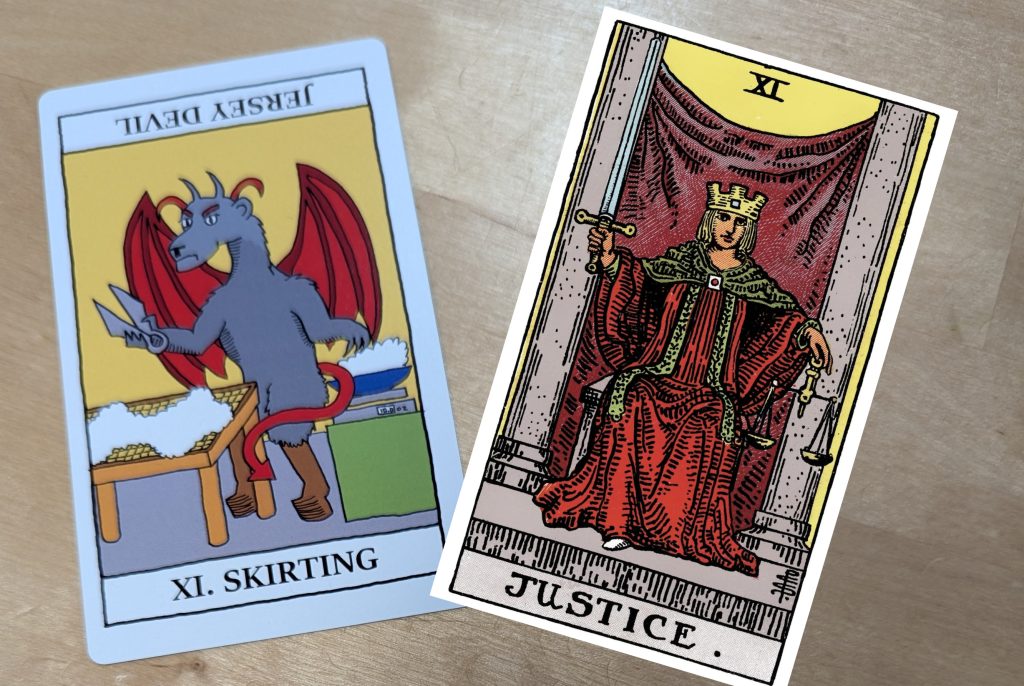
So I’ve been listening to “You’re Wrong About” and got to the episode with Amanda Knox entitled “What Even Is Justice?”
Strap in, because I have thoughts. I’m also in the middle of reading Unmask Alice (inspired by another episode of the same podcast), which covers so many of the moral panics of the 1970s, 80s, and 90s.
I’m also going to throw in the Enneagram. This is one of those pseudo-scientific personality tests that one shouldn’t take overly seriously, but has enough truth to it that when something resonates, it can lead you to deeper truths–like the Tarot. Tools that inspire introspection don’t need to be scientific: it’s the introspection itself that is valuable, not the tools.
Maybe you’ve noticed, but I’m kind of a high-strung guy. Knitting has helped me become a more patient person, but I’m prone to lashing out in my no-so-great moments. It bothers me when things are not right. I’m a middle child, and growing up I would perpetually say “That’s not fair!” (To which my father would inevitably answer, “I never promised you life would be fair.”) But part of being raised a white man in this culture has been the expectation of ease and entitlement, and the perception of that ease as “fairness.” Ease was not what I mostly experienced growing up, and maybe that’s why I always felt things were so unfair.
Every kid gets teased to some extent, gets bullied to some extent, I guess. But for me, it felt really extreme for a long time. I was a “sensitive” kid, which meant it was easy to make me cry, which made me a target. I never really got beat up, but I got threatened a lot, and I got made fun of a lot, and there were years of school where I felt like I had no friends, or one friend, and everyone else was indifferent at best or tormenting at worst. Looking back, I can see how I put myself in the crosshairs without realizing it: when asked to share our favorite song with the class, I brought in Beethoven’s 6th Symphony. I was a nerd from a very young age at a time when that still meant social death.
It made me angry to be treated that way. I didn’t understand why liking Tolkein instead of football meant I got to be shunned and scorned. I felt like the people who made me suffer should be the ones suffering instead. It’s been hard for me to escape from that model of justice: that tormentors deserve to be tormented. Even knowing what I know now about the moral panics of the time, the gender roles that had to be tightly screwed down because society was changing, even after making friends with one of my bullies because actually–just like in the afterschool specials–what he really wanted was attention, the hurt within me still wants to lash out.
When my sister-in-law convinced us all to take an Ennegram test one Thanksgiving, I figured it would be a lark, like astrology. But the results placed Elizabeth and I as a mix of #1 and #5, with me primarily #1 and her primarily #5. This really made a lot of sense to me: Elizabeth as The Investigator, who wants to figure out how to fix things, implement systems that will organize and run smoothly. I also want to fix things, but as The Reformer, I want people to be called to account, to take responsibility for misdeeds. To me, it doesn’t feel adequate just to solve the problem–I want an apology, Goddammit! Being aware of this sometimes helps me to deescalate my feelings. I think, on the whole, it’s healthier to be able to let things go. It’s just constitutionally difficult for me.
It’s clear the criminal justice system in this country is broken and has been from the start. Retributive justice, no matter how emotionally satisfying it might feel, is just spreading suffering around. Restorative justice seems like a much better goal. The biggest problem with that is that it takes an enormous amount of resources to truly work. Without a lot of societal power (and money) behind it, it’s just for show and provides neither restoration nor justice. Those resources are not coming any time soon, I’m afraid. Amanda Knox talked about a Quarantine Model of justice that’s a more achievable goal: people who are deemed dangerous to society are still cordoned off, but without the purpose of assigning blame and creating suffering. Of course, there’s always the problem of who does the judging, but so much weight could be removed by removing the frame of good vs. evil.
Humans are still animals, after all. We might be the only animals with a sense of justice, but we’re not the only animals who hurt each other, dominate each other, kill each other. It’s not as unnatural as we like to think. And if we’re going to deal with it, we need to send fewer Reformers and more Investigators. It’s possible to define “Fairness” in different ways, and the last hundred years has seen a flood of propaganda against “To each according to their need, from each according to their ability,” but given enough accountability I’ve never seen a better definition.
As we work this year to expand out community into the Craft Underground, we want to make it a space for everyone who needs it. We want to be welcoming and not cliquish. We want people to craft with us even if they don’t have a lot of money to contribute. We want awkward people (myself included) to find their place, but we want to hold people who cause problems to account and not let bad behavior slide because we don’t like confrontation. Building an open community takes justice and compassion, and we have to look deeply into what those things mean. The moral panics of today are just as ridiculous as the supposed Satanic cults and men in white vans offering candy to children were when I was growing up. We need to offer counterprogramming and spaces of connection that debunk the hate and fear passed around so casually.
That’s probably enough ranting for now. If it doesn’t make sense, it’s probably because I got norovirus halfway through writing it. I’ve had a number of people lately say they like the blog, and that means a lot! So this post is maybe a little deeper than usual, but there it is.