We want to connect with you, but we’ve come to the conclusion that “social media” is built to be antisocial. So we’ve built our own feed here (or as they used to be called, “blog,” lol). We’ll try to post most days that we’re open. If you want to be part of the conversation, join our Discord!
We include everyone at Purl’s, except people who are intolerant or hateful.
For information about our brick-and-mortar shop in Asheville, including address, hours, map, etc.
Info about our shop
Online Store
For information about our stitch groups and community activities, our class schedule, and other events
Okay, I’m a Hasbro hater and I mostly play Shadowdark these days, but I’m surprised that I’m just finding out about the Dungeons & Dragons crochet book now. Enter the contest to win Lion Brand yarn.
Books are tricky for yarn shops to stock. People are buying fewer of them, and our big distributors carry very few titles now, which means if we want books we have to order direct from the publisher. Industry consolidation has made that not impossible, but it still means we can’t get every book we might want.
So if we don’t have a book you want, don’t feel bad about buying it elsewhere, unless you buy it from Amazon (then you should feel bad).
Okay I know it’s Wednesday, but that’s like Monday for us and it’s alliterative.
You know how sometimes a song will just stop you dead in your tracks? I was driving home from work sometime in 2021 and heard “Heat Wave” on the radio and had to look up “who is this?” and discovered Snail Mail.
Lindsey Jordan is an incredible guitarist and great songwriter coming out of Baltimore as a teenager. She lives in North Carolina now and has a new album coming out March 27. The first single is called “Dead End” and the video involves cryptid hunting.
But I like the second video even better. Snail Mail is playing the Orange Peel on April 21, and I have tickets!
I’ve encountered some knitters, and even a few crocheters, who are a little closed-minded. They say things like “you’re doing that wrong,” or “you should knit Continental because it’s faster” instead of something like “would you like to see a different way of doing that?”
We live in a society where people insist there’s a right way and a wrong way to do things, where authority figures preach that only their methods are correct and that if you follow another path you are doomed or poisonous. But for the most part, crafters are not like that: we value looking at things in different ways and figuring out what feels best in our hands.
My favorite knitting book is Anna Zilboorg’s Knitting For Anarchists. It looks closely at how the loops of various stitches physically connect to each other and at all the ways those connections can be accomplished. There’s no “best way” or “right way.” There ARE ways that won’t get you what you want, but there’s no moral value on making mistakes — something only needs to be “fixed” if the maker finds it unsatisfactory.
What I love about the crafting community is how warmly it embraces new crafters. How eager we are to teach people who want to learn. But always teach and embrace with care and without judgement. Everyone holds things a little differently and moves yarn and stitches and tools around in their own unique way. I’m always fascinated to watch someone else’s hands moving, and at how many different “right ways” there are to be in the world.
If you’re not on Discord, or attending one of our stitch groups, you might have missed the TV sensation that’s spreading through our stitchers like wildfire (or herpes?): the Hallmark Channel show (now on Netflix), The Way Home. I describe it as “Gilmore Girls meets Doctor Who.” Three generations of women in a family struggle to get their lives on track (Asheville’s own Andie McDowell, Grey’s Anatomy star Chyler Leigh, and newcomer Sadie Laflamme-Snow) while jumping in and out of a time-travelling pond. It’s kind of like Outlander without all the raping and Scottish accents. It’s also addictive watching as you try to puzzle out how the time travel works, and if there is a purpose to all the getting damp. The characters make terrible life choices, but don’t we all? It’s a lot of fun, and Season 4 (the final one) starts in April. If you want to join in the discussion, start watching and join our thread on Discord. Or let us in or YOUR favorite show, because sometimes the hidden gems outshine the blockbusters.
Some days I get into philosophical discussions with our Fed Ex guy. But today someone called “from the US Military” wanting to source “a large number of Boye crochet hooks.” He sounded legit, and told me what GSA paperwork I’d need to fill out, but I had to break it to him that I only had 3 in stock and all the rest were Susan Bates. I gave him the numbers of three of our notions suppliers, but did I do the right thing? Was he just trying to “hook up” our troops with some nice leisure supplies? Or does the Army have some nefarious plans involving crochet? The mind boggles.
We’ve admired Kelbourne Woolens for a long time. Not only do they have some really great yarns, they seem like really cool people. When you find kindred spirits in this industry, it’s important to support them. We’re sorry it’s taken this long to introduce some of their yarns, but you’ll be seeing more and more, we promise! Over time, you’ll see us phasing out private-equity owned brands in favor of independent suppliers and family-owned businesses (did you know Lion Brand has been owned by the same family since 1878?). Private equity is all about squeezing as much money out of a property as possible, even when that means destroying it in the process (JoAnne’s, for instance). Meanwhile, Courtney Kelley and Kate Gagnon Osborn have worked hard to create great yarns like Germantown, a non-superwash worsted weight wool made in the USA; Cricket, a fingering weight single ply tweed imported from Ireland; and Harmony, a silk-mohair blend in many gorgeous colors. While brands owned by private equity are cutting ties with influencers who are making the Melt the Ice hat, Kelbourne has been outspoken about their progressive values.
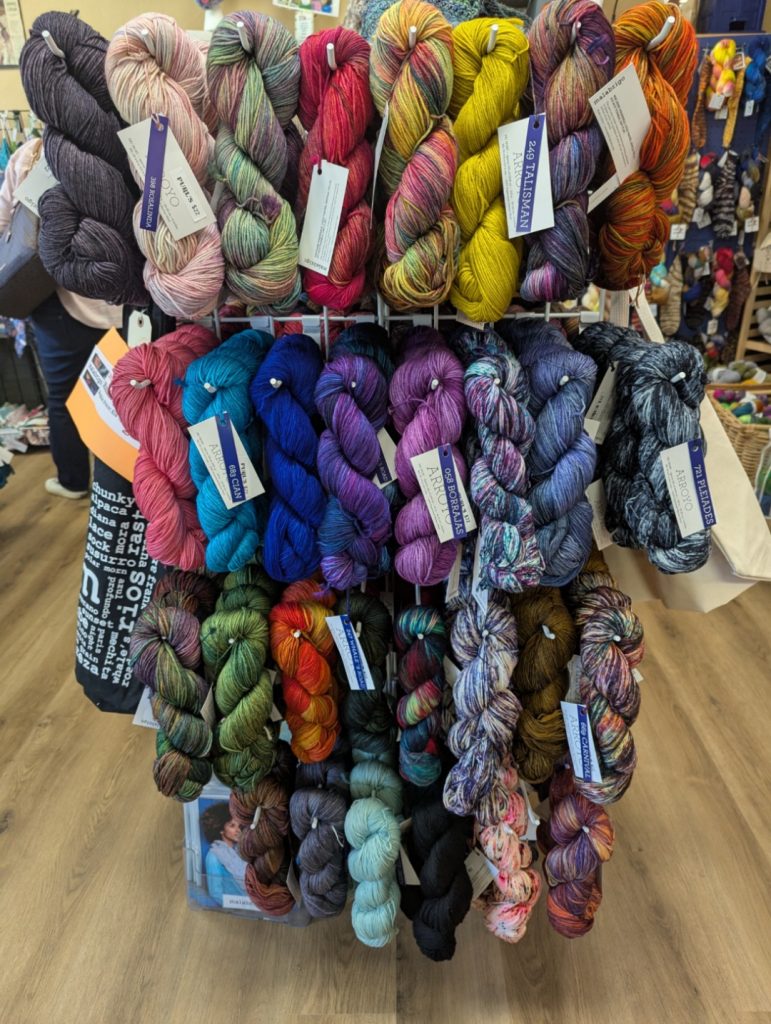
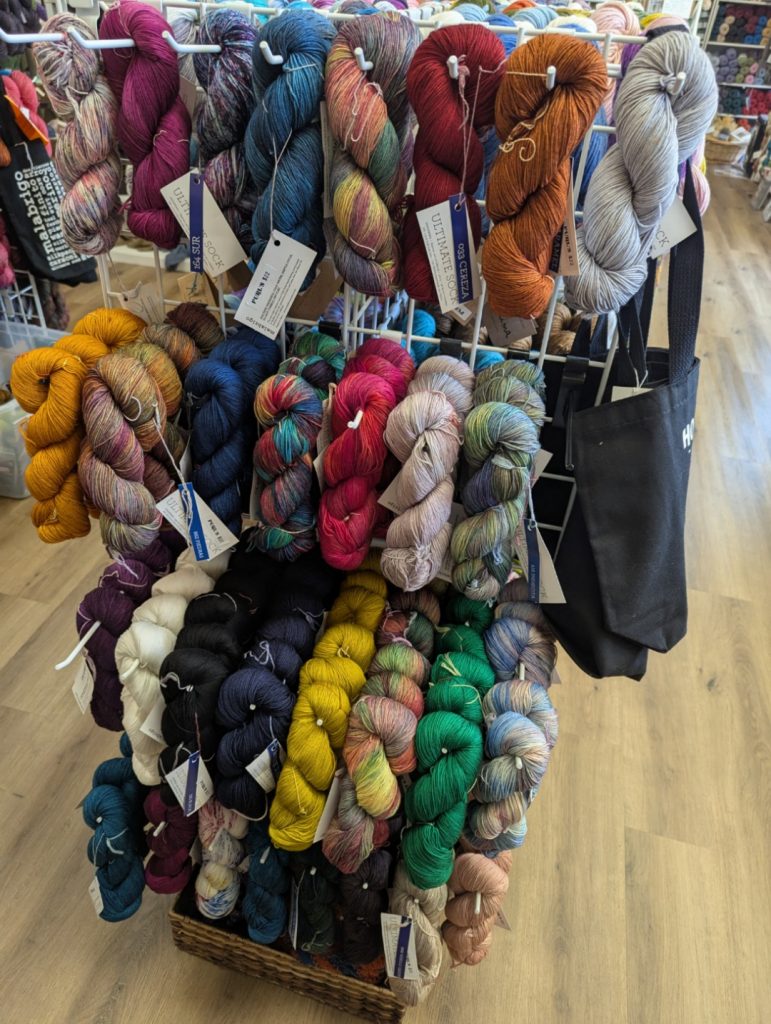
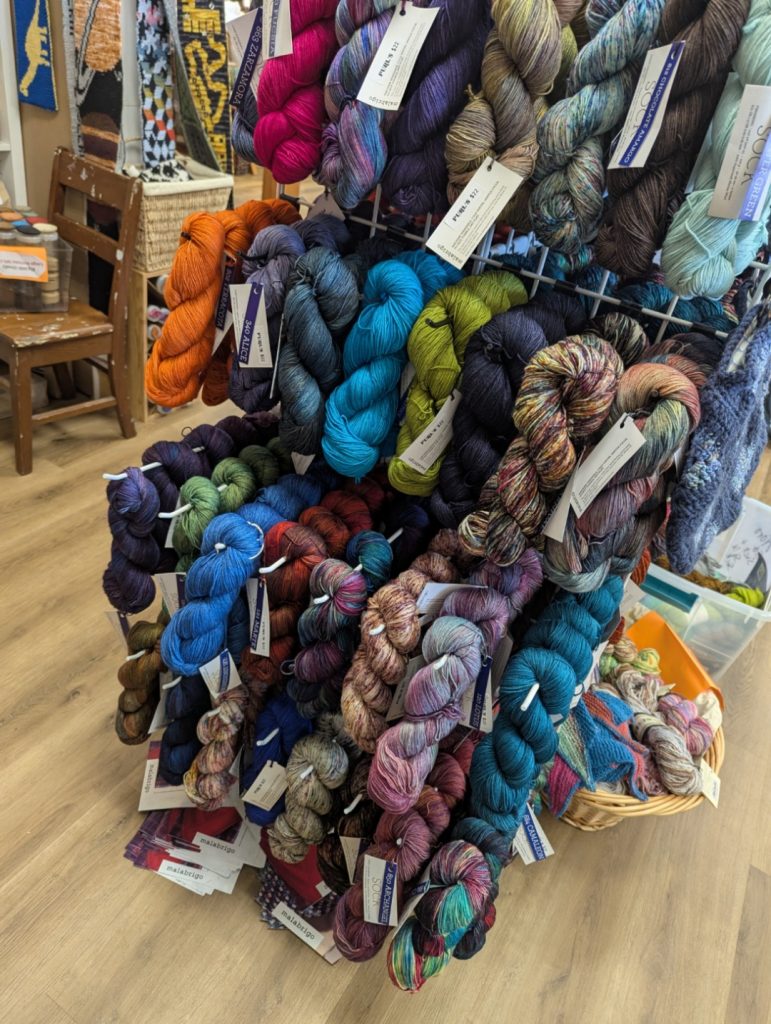
It always feels good to get a big shipment of yarn! We are full up again on Rios, Arroyo, Mecha, Rasta, Sock, and Ultimate Sock, at the best prices in town. Come and get it while we have lots of choices.
If we’re going to have to be the sandwich generation, we should at least get to eat a sandwich! Thanks for being patient as we’ve been juggling caregiving, stomach bugs, and retail. Being a Mom & Pop means that sometimes both Mom AND Pop are down for the count. Thanks for making us REALLY WANT to come back to work, because we miss you when we don’t get to see y’all! See you at the shop, or come say hi on Zoom tonight.
Strap in, because I have thoughts. I’m also in the middle of reading Unmask Alice (inspired by another episode of the same podcast), which covers so many of the moral panics of the 1970s, 80s, and 90s.
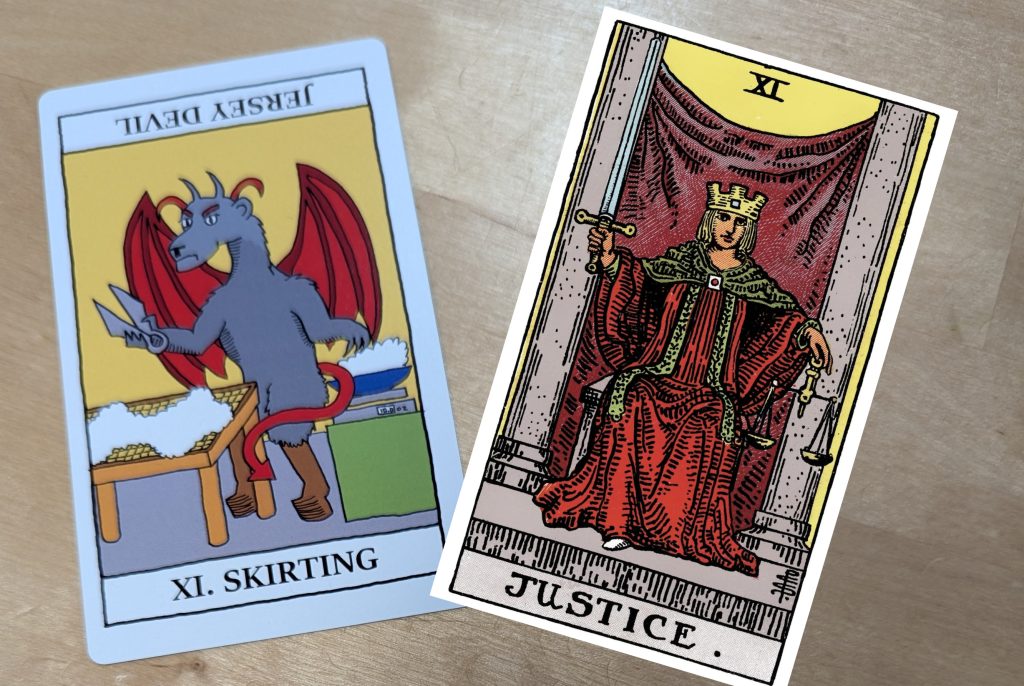
I’m also going to throw in the Enneagram. This is one of those pseudo-scientific personality tests that one shouldn’t take overly seriously, but has enough truth to it that when something resonates, it can lead you to deeper truths–like the Tarot. Tools that inspire introspection don’t need to be scientific: it’s the introspection itself that is valuable, not the tools.
Maybe you’ve noticed, but I’m kind of a high-strung guy. Knitting has helped me become a more patient person, but I’m prone to lashing out in my no-so-great moments. It bothers me when things are not right. I’m a middle child, and growing up I would perpetually say “That’s not fair!” (To which my father would inevitably answer, “I never promised you life would be fair.”) But part of being raised a white man in this culture has been the expectation of ease and entitlement, and the perception of that ease as “fairness.” Ease was not what I mostly experienced growing up, and maybe that’s why I always felt things were so unfair.
Every kid gets teased to some extent, gets bullied to some extent, I guess. But for me, it felt really extreme for a long time. I was a “sensitive” kid, which meant it was easy to make me cry, which made me a target. I never really got beat up, but I got threatened a lot, and I got made fun of a lot, and there were years of school where I felt like I had no friends, or one friend, and everyone else was indifferent at best or tormenting at worst. Looking back, I can see how I put myself in the crosshairs without realizing it: when asked to share our favorite song with the class, I brought in Beethoven’s 6th Symphony. I was a nerd from a very young age at a time when that still meant social death.
It made me angry to be treated that way. I didn’t understand why liking Tolkein instead of football meant I got to be shunned and scorned. I felt like the people who made me suffer should be the ones suffering instead. It’s been hard for me to escape from that model of justice: that tormentors deserve to be tormented. Even knowing what I know now about the moral panics of the time, the gender roles that had to be tightly screwed down because society was changing, even after making friends with one of my bullies because actually–just like in the afterschool specials–what he really wanted was attention, the hurt within me still wants to lash out.
When my sister-in-law convinced us all to take an Ennegram test one Thanksgiving, I figured it would be a lark, like astrology. But the results placed Elizabeth and I as a mix of #1 and #5, with me primarily #1 and her primarily #5. This really made a lot of sense to me: Elizabeth as The Investigator, who wants to figure out how to fix things, implement systems that will organize and run smoothly. I also want to fix things, but as The Reformer, I want people to be called to account, to take responsibility for misdeeds. To me, it doesn’t feel adequate just to solve the problem–I want an apology, Goddammit! Being aware of this sometimes helps me to deescalate my feelings. I think, on the whole, it’s healthier to be able to let things go. It’s just constitutionally difficult for me.
It’s clear the criminal justice system in this country is broken and has been from the start. Retributive justice, no matter how emotionally satisfying it might feel, is just spreading suffering around. Restorative justice seems like a much better goal. The biggest problem with that is that it takes an enormous amount of resources to truly work. Without a lot of societal power (and money) behind it, it’s just for show and provides neither restoration nor justice. Those resources are not coming any time soon, I’m afraid. Amanda Knox talked about a Quarantine Model of justice that’s a more achievable goal: people who are deemed dangerous to society are still cordoned off, but without the purpose of assigning blame and creating suffering. Of course, there’s always the problem of who does the judging, but so much weight could be removed by removing the frame of good vs. evil.
Humans are still animals, after all. We might be the only animals with a sense of justice, but we’re not the only animals who hurt each other, dominate each other, kill each other. It’s not as unnatural as we like to think. And if we’re going to deal with it, we need to send fewer Reformers and more Investigators. It’s possible to define “Fairness” in different ways, and the last hundred years has seen a flood of propaganda against “To each according to their need, from each according to their ability,” but given enough accountability I’ve never seen a better definition.
As we work this year to expand out community into the Craft Underground, we want to make it a space for everyone who needs it. We want to be welcoming and not cliquish. We want people to craft with us even if they don’t have a lot of money to contribute. We want awkward people (myself included) to find their place, but we want to hold people who cause problems to account and not let bad behavior slide because we don’t like confrontation. Building an open community takes justice and compassion, and we have to look deeply into what those things mean. The moral panics of today are just as ridiculous as the supposed Satanic cults and men in white vans offering candy to children were when I was growing up. We need to offer counterprogramming and spaces of connection that debunk the hate and fear passed around so casually.
That’s probably enough ranting for now. If it doesn’t make sense, it’s probably because I got norovirus halfway through writing it. I’ve had a number of people lately say they like the blog, and that means a lot! So this post is maybe a little deeper than usual, but there it is.